Creek life
South-east Australia
04/06/19
With the amount of hours I have spent wading and wandering the mountain and lowland creeks of SE Australia I'm surely half fish by now. The whole different world of macrophytes and aquatic fauna I find incredibly interesting.

A mountain creek in NSW.
The inland waters of Australia are characteristically prone to low and variable rainfall, which has shaped the unique diversity, endemicity and phenology of our freshwater fish. The majority of Australian fish are brackish-tolerant, giving them the ability to retreat to more coastal waters in times of drought. As such, most fish east of the Great Dividing Range are diadromous (usually catadromous), although some are also able to breed in land-locked waters.

A mountain creek in Victoria.
In terms of habitat, the Murray Darling Basin is the most important freshwater system in southeastern Australia, and is home to over 60 native fish species (e.g. Australian smelt, Western carp gudgeon, Common Jollytail), as well as the continent’s largest fish, Murray Cod. However, alongside these native populations reside a range of introduced species. Some, most notably trout, are perceived to have social and economic benefits for recreational fisheries, and are actively stocked, whilst other species are more problematic. For example, Eastern Gambusia was introduced in the early 1900’s in a failed attempt to control mosquito populations and has now threatened several natives through predation and competition. Additionally, southeastern freshwater fish now also face various anthropogenic stressors.

Galaxias maculatus & Hypseleotris compressa
Common Jollytails & Empire Gudgeon
The empire gudgeon (on top) is a juvenile. Males can develop into large (12cm), spectacularly coloured fish but I have never caught such individuals. They look quite similar to other Hypseleotris species when small. The longer galaxias below are very fast and active, shoaling fish.

Odonata, Megaloptera...
Macroinvertebrates
A few different predatory macroinvertebrate species here. They are generally good indicators of water quality, some being very sensitive, and so are often used as a standard in aquatic environmental assessments.

Myriophyllum variifolium
Varied Water-milfoil
A highly variable myriophyllum species. This one is a red form.

Myriophyllum variifolium
Varied Water-milfoil
The emergent form of the same plant. Myriophyllum species have different leaf forms adapted to growing above and underwater.
Ref.

Litoria wilcoxii
Wilcox's frog
Closely related to the other two 'stony creek frogs' (Litoria leseurii and Litoria jungguy), this frog was elevated to species status in 2004. It's best distinguished from those species by location - being found north of the Hawkesbury River in NSW (near Forster), well within this species' range. It's mainly found near rocky fast flowing creeks.

Litoria leseurii
Leseur's frog
This frog usually looks very similar to the previous one, but has its 'scared' camouflage pattern on. Many frogs can rapidly change colour like this. This frog was found south of Sydney, which is the northernmost border of the species' range.

Euastacus australasiensis
Sydney spiny crayfish
Euastacus are generally high altitude crayfish living in the pristine mountain streams of the Great Dividing Range. This species is found around Sydney and grows to about 7cm - far smaller and less aggressive than the other Euastacus species in the area.

Litoria citropa
Blue Mountains tree frog
A stream dwelling tree frog that prefers higher altitude areas on the East coast. It has quite slow developing tadpoles, taking up to 4 months to metamorphose.

Macrobrachium australiense
Common Australian River Prawn
A carnivorous and detritivorous palaemonid shrimp. They grow to 7cm and are fairly aggressive, trying to eat anything they can catch with their claws. Generally found in freshwater, they can also tolerate brackish water - an important part of their life cycle.

Litoria fallax
Eastern sedge frog
A very cute tiny tree frog that lives in vegetation along permanent water bodies. During the day they hide in the leaf-axils of plants, often sedges, which is where they get their name.

Alterations to the flow regimes of rivers as a result of damming and weiring often have severe impacts for fish species; changing their habitat, increasing fragmentation and hindering migration. Many fish species are now locally extinct from certain areas, unable to travel beyond dam walls to repopulate. The clearing of riparian vegetation also accelerates bank erosion, which in turn, contributes to in-stream siltation levels and the degradation of complex habitats used for spawning and sheltering. Such pressures on our native fish were recently given the spotlight with the fish-kill controversy in the Murray Darling, highlighting the impacts that we have on the viability and integrity of fish populations. Events like these emphasise the fragility of already very low fish populations, which may need increasing attention given additional climate-induced stresses.

Even in the same river system, differing areas can hold different kinds of animals. Lentic waters are slow moving or standing, like ponds and lakes, and lotic systems are running, like fast flowing highwater riffles.

Laccotrephes tristis
Water scorpion
A large predatory water insect that uses its front claws to catch tadpoles and fish. At the other end, a respiratory siphon is what the bug uses to breathe with while its body is underwater.

Cherax destructor
Common yabby
The most widespread Australian crayfish. It's extremely hardy and can survive droughts over many years by burrowing deep into river beds. They get their binomial name from the damage they can do to dams with their extensive burrowing. Southern Australian crayfish can largely be divided into hardy lowland generalists in the Cherax genus and specialist upland species in the Euastacus genus (a parallel that can be drawn with many other aquatic groups).

Emydura macquarii
Murray River turtle
A widespread short-necked freshwater turtle species. This may be a species complex, and many subspecies currently have uncertain status. These omnivorous turtles are very hardy and spend almost all of their time in the water except when basking. Their carapace gets to about 30cm in diameter.

Emydura macquarii
Murray River turtle
A hatchling! The baby turtles usually hatch in late summer from sandy patches and loose soil surrounding the water body - although it can be quite a few meters away through scrub!

Emydura macquarii
Murray River turtle
A few scraps of eggshell from around the nest. Clutches size can be up to 30 eggs.

Intellagama lesueurii
Australian water dragon
Found across the east coast of Australia, this large agamid lizard fills the country's 'iguana niche'. Being semi-aquatic, they are almost always found in close proximity to a water body, and can stay submerged underwater for up to an hour. They are quite powerful and can grow to be over 1m in length.

Eulamprus quoyii
Eastern Water Skink
True to its name, this lizard lives around streams. It eats primarily insects - although fish and tadpoles can also form a part of its diet, as well as any fruit it forages. They brumate in winter, not doing much, and don't really need to eat during this time.
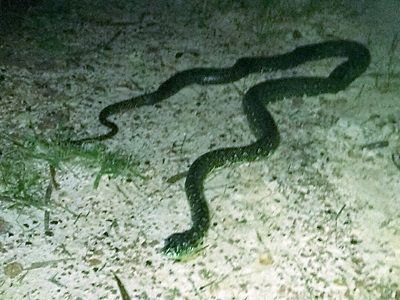
Morelia spilota spilota
Diamond Python
Like all pythons, this snake kills its prey via constriction. This is one of 8 recognised subspecies of carpet python (Morelia spilota), and can be found in bushland areas along coastal NSW.

Carassius auratus
Goldfish
Alongside carp, this very successful invasive fish can now be found in most river systems in South-eastern Australia. Australia has no native cyprinids, and these fish originated from aquarium releases in the 1860s.

Chelodina longicollis
Eastern long-necked turtle
A very interesting turtle, like others in this genus. Australia only has pleurodire turtle species (side-necked turtles that can't retract their head into the carapace) so the long neck of this species, which is longer than its body length, is usually out in the open. They are very hardy and can migrate for long distances over land to discover new areas to live in, like dams.
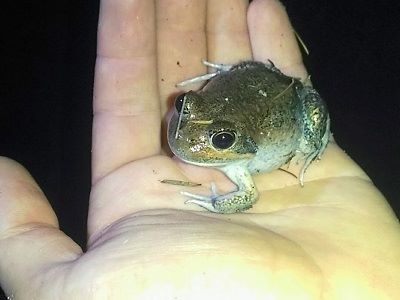
Limnodynastes dumerilii
Eastern banjo frog
A large pond dwelling frog that can also burrow. They have a distinct call that has earned them the name 'pobblebonk'. After spawning, females will continue to take care of the eggs, taking air to the foam nest to keep the eggs oxygenated.

Limnodynastes peronii
Striped marsh frog
A hardy frog that can tolerate water conditions that many other frogs can't. They are aggressive breeders and can be even found in urban environments. They hibernate through the winter.

Pseudogobius olorum
Bluespot Goby
Surprisingly, Australian fish aren't very well known and many taxa need revision. This is one such species, previously known as Pseudogobius olorum, but given the temporary label Pseudogobius sp. 9 while this species complex undergoes taxonomic resolution. It is a fish that can live in fresh and brackish water and grows to about 4cm. As a goby, it is benthic, living amongst rocks and other hiding places.

Days well spent.