Freshwater and brackish fish
Tropical Queensland, Australia
19/02/21

Mountain streams and riffles. While bedrock rivers rarely contain as many different species as those with alluvium, they are a relief in these areas because stinging trees can't grow on the banks!
These are some of the fish I have found in the creeks and rivers here. Many of the fish in this region are considered euryhaline, tolerating a wide range of salinities from full fresh to full saltwater in some species. I've ordered them in distance found from the coast with species found in more brackish water at the end.
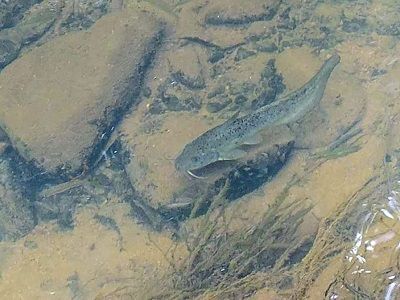
Tandanus tropicanus
Wet Tropics Tandan
This tropical catfish was recognised as a distinct species from its more common congener, Tandanus tandanus, in 2014. They are found in eastern flowing drainages from about Cape Tribulation to Innisfail. Like most eel-tail catfish, they are quite social and are usual found in small schools.

Neosilurus hyrtlii
Hyrtl's Catfish
One of the more beautiful Australian freshwater catfish, with delicate barbels and usually a uniform silvery bronze colouration. This species is able to persist through the dry season as creeks contract, sometimes living in incredibly hot scattered pools.
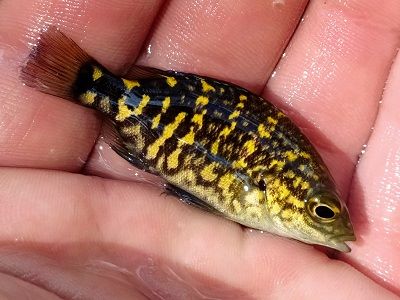
Hephaestus carbo
Coal grunter
A tropical fish that prefers clear waters flowing over sandy substrate. They are quite social, often shoaling with rainbowfish and other grunter species. Juvile fish are very pretty, with a bright gold-flake pattern that catches the sunlight. The colours fade a little as the fish matures, growing up to 30cm.
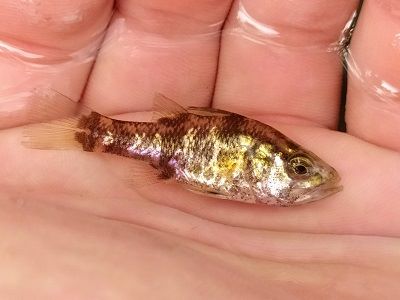
Glossamia aprion
Mouth Almighty
A freshwater cardinalfish that behaves much like its saltwater relatives. It is a mouthbrooder, where males keep the young fry in their buccal cavity for protection. They don't eat during this period, but normally are ambush predators preying on smaller fish and invertebrates.
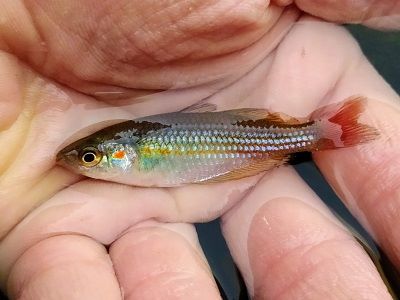
Melanotaenia splendida splendida
Eastern rainbowfish
One of the more widely distributed rainbowfish species in Australia. This species is highly variable, but the splendida subspecies generally has blue scales with orange stripes. Males get long fins and can grow to up to 14cm (although usually just reach 8). They are especially colourful when spawning and courting.
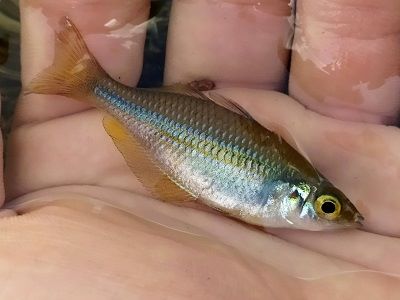
Melanotaenia trifasciata
Banded rainbowfish
Found only in the most northerly parts of Australia, this large rainbowfish is also one of the most beautiful. It is a popular aquarium fish worldwide, with common names like jewel and regal rainbowfish. Like with most rainbowfish, their morphological characteristics vary significantly between locations. This can make them difficult to identify as juveniles look very similar to Melanotaenia splendida, however mature specimens look distinct with very deep, laterally compressed bodies.
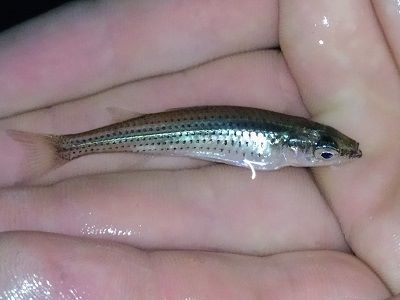
Craterocephalus stercusmuscarum
Flyspecked hardyhead
This is the abundant mid and top-water species that takes over the niche from the Australian smelt that lives further south. They are in the Atherinidae family, a sister family to the rainbowfish and pseudomugils.
Reference
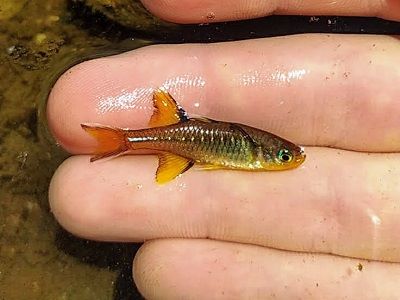
Pseudomugil signifer
Pacific blue-eye
A small, colourful fresh and brackish water fish closely related to rainbowfish. This is the most widespread of the Australian Pseudomugils, and can be found all along the East coast with a variety of colour forms.
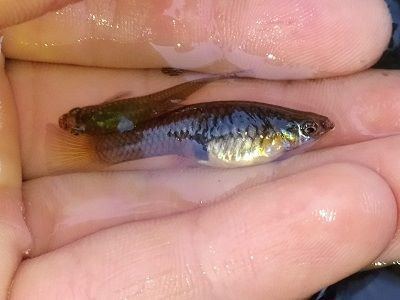
Gambusia holbrooki
Eastern gambusia
An introduced fish that has taken over much of Australia's waterways. They were introduced in the 1920's to manage mosquitos, and instead they now threaten many fish and frog species. They are more aggressive and nippy than native fish species, and are also much faster breeders, being livebearers.
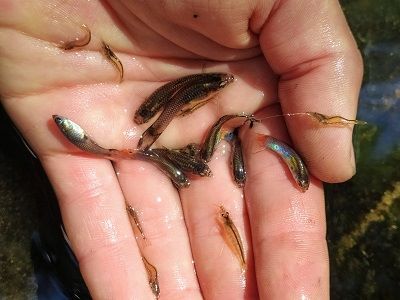
Poecilia wingei
Endler guppy
Another introduced species, found sporadically throughout the tropics as a result of aquarium-related introductions. They are also livebearers, and by constantly reproducing they can quickly outcompete similar species like rainbowfish and hardyheads that would normally inhabit such creeks.
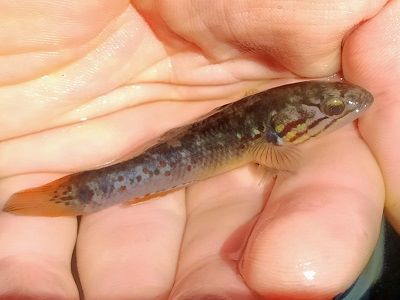
Mogurnda mogurnda
Northern Purple Spotted Gudgeon
These colourful fish are generally bottom dwellers and ambush predators, and particularly like to hide in vegetation. They are good climbers and can migrate into the highest reaches of freshwater stream systems.
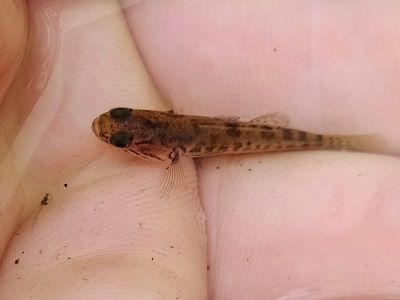
Mogurnda mogurnda
Northern Purple Spotted Gudgeon
The less colourful juvenile. They can get to 20cm, becoming quite plump as they age. When young they behave much like gobies, to which they are related.
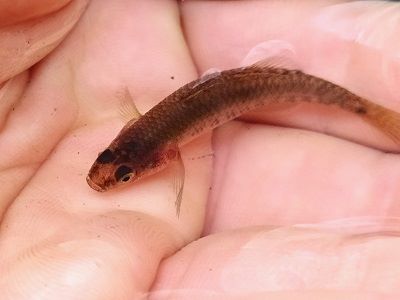
Hypseleotris compressa
Empire gudgeon
A peaceful fish that is quite active for a gudgeon. It is found across much of Australia, in rivers near the coast due to their diadromous lifestyle. The males get a bulbous head and turn a vibrant bright red colour during breeding times.
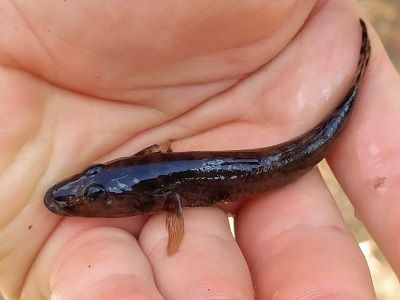
Glossogobius aureus
Golden Flathead Goby
A bottom-dwelling carnivore that grows to about 14cm. Their flat body shape and superior mouth (upwardly turned) are telltale signs of an ambush predator lifestyle. Adults usually migrate to the sea to breed, however this is not a crucial requirement.
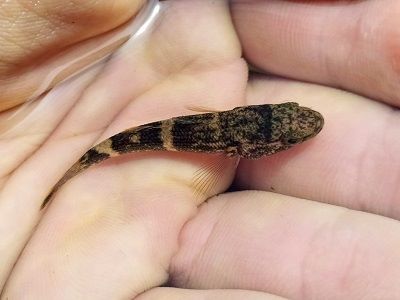
Ophiocara porocephala
Spangled Gudgeon
A predatory gudgeon that prefers muddy bottom estuaries to live in. They get to 30cm, with juveniles like this one living in freshwater. The males guard the eggs after breeding.

Amniataba percoides
Barred Grunter
An omnivorous grunter that is highly adaptible to both temperature and water conditions, even tolerating brackish water. They are fairly aggressive and reach sexual maturity at under 10cm.
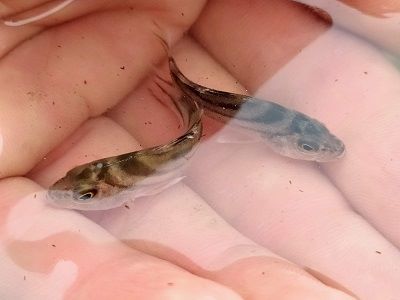
Terapon jarbua
Crescent grunter
Grunters are named after the sounds they make which are produced by muscles drumming on their swimbladder. It is likely that they use these sounds to communicate and potentially ward off predators. The juvenile fish often act as nefarious cleaner fish, cheating the universally understood symbiotic relationship in the fish world (where cleaner fish eat parasites off of host fish), and eat the scales and mucous of the host fish instead.
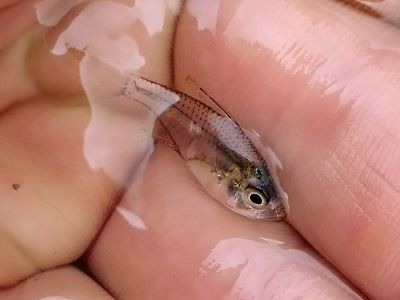
Ambassis marianus
Estuary glassfish
A small semi-transparent fish that lives in schools in estuaries, freshwater and saltwater. They generally congregate near cover like fallen branches or mangrove roots.
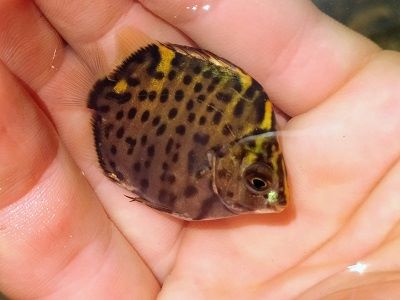
Scatophagus argus
Spotted scat
A brackish water fish that lives mainly in freshwater as a juvenile. Also called Red Scats, these fish have venemous spines which can inflict a painful wound that can cause partial paralysis. As they mature they lose their colour, becoming mostly silver with dark spots.
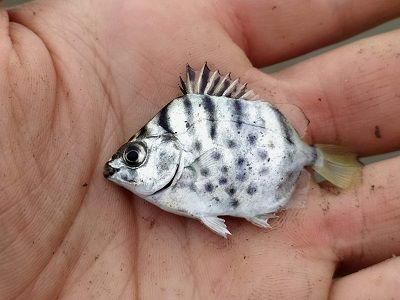
Selenotoca multifasciata
Striped scat
These fish also have venom glands at the base of their spines, so care must be taken when handling. They are quite similar in behaviour to Spotted scats, and can be found all along the North and East coasts of Australia.
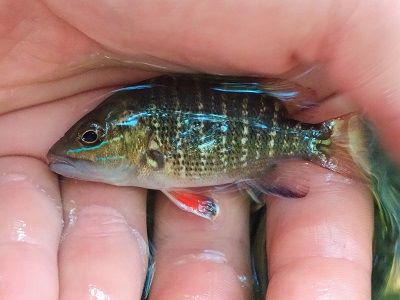
Lutjanus argentimaculatus
Mangrove jack
These fish also begin their lives in freshwater. They are a tropical snapper, and as they mature they become bright red and move out to live in estuaries and reefs. They are very long lived and can reach almost 60 years and grow to over a meter in length. They are ambush predators and have large canine teeth to seize their prey with.
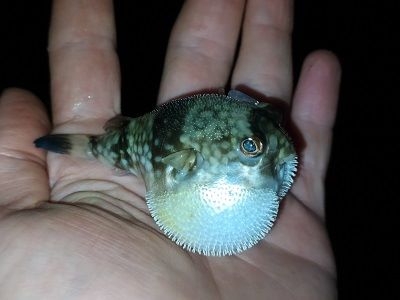
Tetractenos hamiltoni
Common Toadfish
A normally estuarine fish that sometimes ventures into full fresh water looking for food (like a few other pufferfish species). It is very toxic and is lethal if eaten, due to the presence of tetrodotoxin. Because of this they are not fearful of predators and often seem very friendly.

Strongylura krefftii
Freshwater Longtom
A carnivorous ambush predator that feeds primarily on surface dwelling fish. They are fast swimmers and aggressive feeders, rushing out to investigate any surface agitation. These tropical fish can get up to a massive 85cm and prefer slow moving sheltered waters.
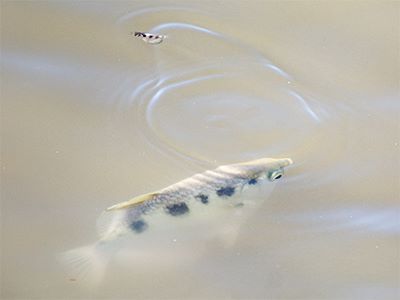
Toxotes chatareus
Sevenspot Archerfish
Attempted cannibalism! This archerfish just tried to eat a juvenile of its own species, which just managed to dart away. These freshwater and estuarine fish are famous for their ability to spit up jets of waters to knock down insects.
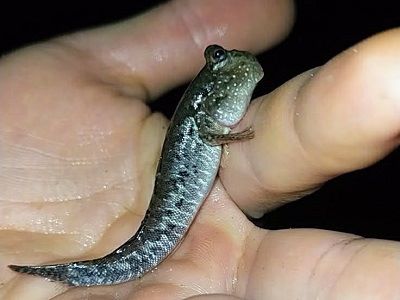
Periophthalmus argentilineatus
Barred mudskipper
One of my favourite fish, these gobies can survive out of water! They can absorb oxygen directly from the air via their skin and the inside of their mouths.
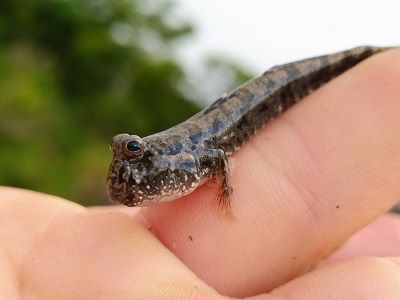
Periophthalmus argentilineatus
Barred mudskipper
They mostly live in brackish areas around mangroves but can extend far into the freshwater reaches of streams as well. During low tide they will sit on land, hopping away if disturbed. During high tide they usually hide away inside their burrows.
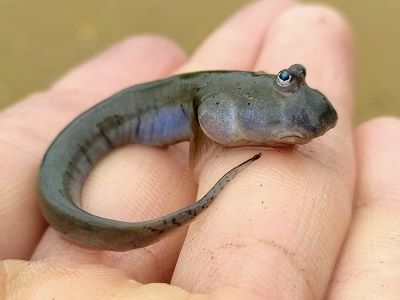
Scartelaos histophorus
Bearded mudskipper
A more eel-like mudskipper species that is quite finicky about its habitat. They like very soft mud in estuaries, and can only be found on the right type of brackish mudflat. They disappear down burrows very quickly when approached. Males have a tall dorsal fin that they raise up when courting.
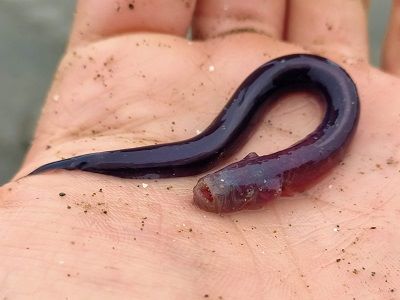
Taenioides mordax
Eastern Eelgoby
An incredibly cryptic and poorly known species that inhabits deep burrows in silty estuaries and rivers. Also called wormgobies, they are assumed to be ambush predators that rely on motion related senses to hunt. Their eyes are significantly reduced and this species is likely blind.
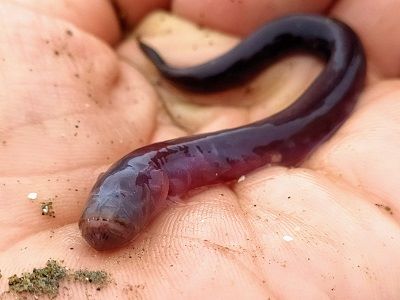
Taenioides mordax
Eastern Eelgoby
A scaleless fish, these eel-like gobies can move easily through soft substrate. This one was found in a very silty riverbed in brackish water.
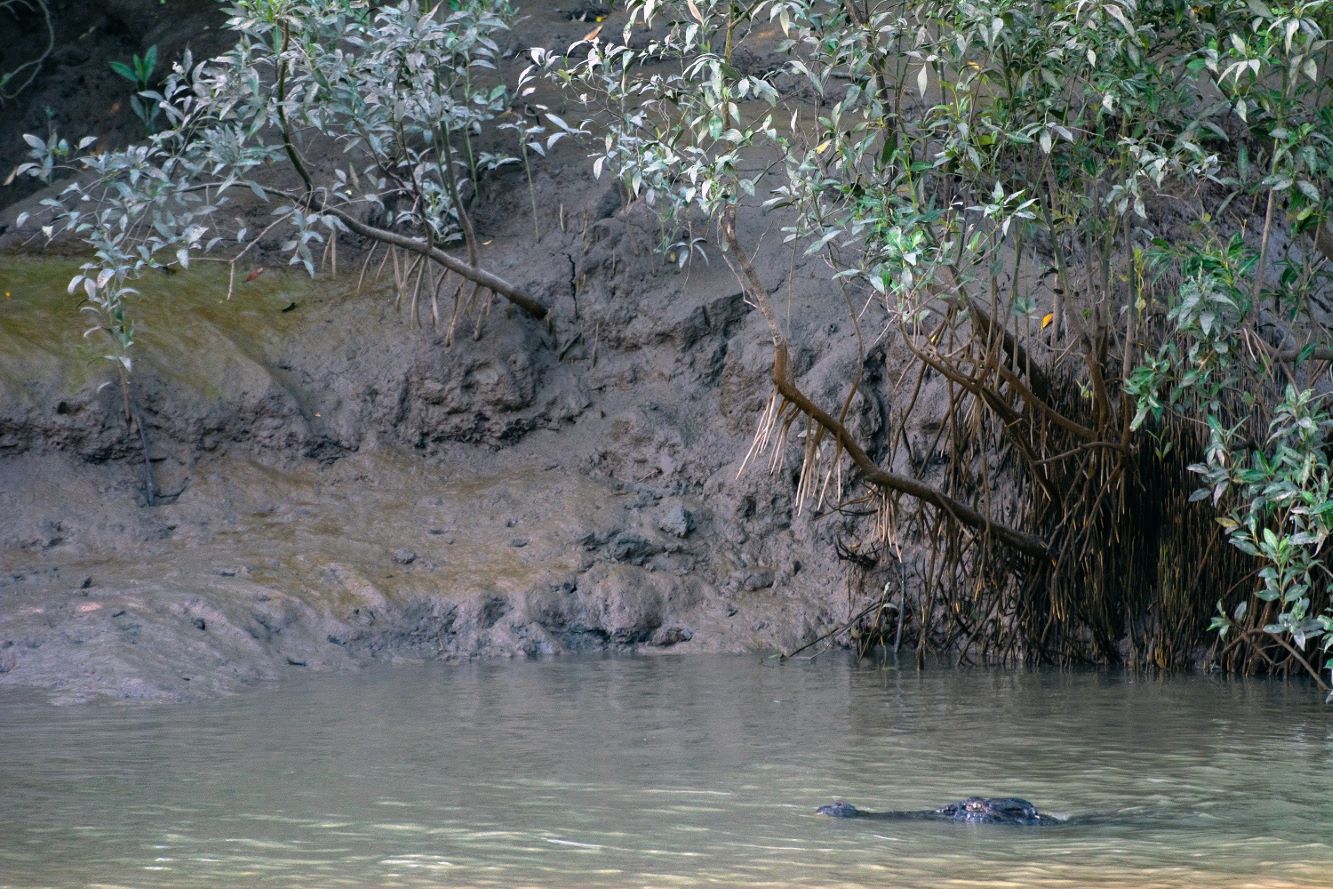
Exploring creeks can be a lot more dangerous in the tropics, with large crocodiles completely hidden in even shallow streams of water. This is a 'saltwater' crocodile, Crocodylus porosus, in freshwater (with tidal changes bringing in brackish water at high tide).