Pitcher plants - Nepenthes
Borneo, South East Asia
24/02/21
As a plant lover, I have always been drawn to the incredible Nepenthes genus - the pitcher plants. They are a group of carnivorous plants that have highly specialised leaves that allow them to create water-holding traps! And nowhere is this kind of plant more abundant and speciose than on the island of Borneo... in fact that was a large reason for me to want to go exploring there.
Walking around in the rainforest, you realise just how common they are here! Every few meters there is either a massive scrambling vine disappearing into the trees or a small crop of low-growing pitchers. Nepenthes generally have a two stage growth pattern, with plants taking a few years to mature before becoming vining plants, although some can be exclusively ground-dwellers.
They have evolved in an interesting way, with the 'leaf' part actually being a modified leaf base, the long supporting tendrils are modified petioles, and the pitcher itself is the highly specialised leaf. Many species produce different shaped pitchers at different life stages; most notably lower pitchers closer to the ground and upper pitchers that hang in the canopy. It's thought that this is an adaptation to better catch the different animals living at those levels.
Living in mostly nutrient-poor soils, these plants generally rely on animals for food. While there are many highly specific niche species, generally they contain a cocktail of digestive enzymes that break down any prey that happens to fall in. Their pitchers have slippery sidewalls with downward pointing hairs to prevent escapes and many even lure prey in with sweet and scented nectar.

Nepenthes gracilis
Slender pitcher-plant
One of the most widespread, and therefore successful, pitcher plants in South-east Asia. It's a lowland pitcher that generally lives at altitudes under 100m but can be found up to 1100m (but is generally outcompeted in these areas by more specialised species).

Nepenthes gracilis
Slender pitcher-plant
They are very dainty-looking, with no hairs, fangs, ribbing or so on. They have a very thin lip (peristome) that doesn't form a platform like most other Nepenthes species. Even the shell of the pitcher itself is very thin and flexible.
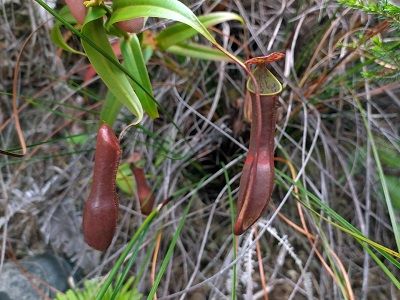
Nepenthes gracilis
Slender pitcher-plant
I've seen these plants in action - raindrops that hit the pitcher lid put enough force on the lightweight pitchers to make any insects hiding underneath the lid drop into the digestive fluid.

Nepenthes rafflesiana
Raffles' pitcher-plant
This is N. rafflesiana in its youngest form. These are the earliest pitchers it produces, immature lower pitchers.

Nepenthes rafflesiana
Raffles' pitcher-plant
This species generally lives in open forests, prefering sandy soils. These are the young lower pitchers. They will get quite solid and hefty, up to 20cm large each.

Nepenthes rafflesiana
Raffles' pitcher-plant
These lower pitchers get pronounced flanges, or wings which you can kind of see here. This is likely so that ground dwelling insects can easily walk up and fall into the pitchers.

Nepenthes rafflesiana
Raffles' pitcher-plant
And here is an upper pitcher of the plant. The switch to making different pitcher forms is believed to be age related rather than a response to environmental factors.

Nepenthes rafflesiana
Raffles' pitcher-plant
They can get up to 15m long, generally growing upwards. Here is an upper pitcher I found with ants feeding from the nectaries (with two already successfully trapped inside).

Nepenthes ampullaria
Narrow-lidded pitcher-plant
Now these are very interesting pitcher plants! They aren't exactly carnivorous but rather they play the long game.

Nepenthes ampullaria
Narrow-lidded pitcher-plant
The pitchers last fairly long, about 6 months each, and don't have an overhanging lids like most other Nepenthes.

Nepenthes ampullaria
Narrow-lidded pitcher-plant
They collect rainwater and actually stay open like little urns to collect leaf litter and falling vegetation. They are one of the most herbivorous pitcher plants!

Nepenthes ampullaria
Narrow-lidded pitcher-plant
They don't have very acidic fluids, and so host a inquiline community of many organisms like mosquito larvae, which break down the things that fall in. However they do still enjoy the odd insect that falls in and dies.

Nepenthes albomarginata
White-collared pitcher-plant
This species is specialised termite predator! The white bands of fine hair (trichomes) attract termites of the Nasutitermitinae family, which walk around the peristome eating it and fall in.

Steamy tropical jungles with plenty of rain are always a good place to go looking for plants.