Jungle biota
Tropical Queensland, Australia
07/03/21

Tropical jungles have such high biodiversity, everywhere you looks holds something interesting. Unfortunately this high abundance of animals also includes potentially dangerous mosquitoes and swarms of hundreds of Culicoides biting midges. Though they are much easier to deal with knowing that they don't transit any diseases, being just a very itchy nuisance. Australia's rainforests are very fragmented, being such a dry continent. Rainforests these days occur in small patches, usually in gullies and valleys. It's very interesting when you can walk through four different biomes in the span of an hour! Mangrove intertidal, Melaleuca swamplands, Eucalypt woodland and rainforest.

Carlia rhomboidalis
Blue-throated Rainbow-Skink
A small diurnal skink that lives in leaf litter. Males get these vibrant colours during the breeding season and certainly aren't hard to miss. They wave their tails and bob their heads to assert dominance.

Carlia longipes
Closed-litter rainbow-skink
The name pretty much says it all. This is a species of rainbow skink that mostly lives in the leaf litter of closed-canopy forests in tropical far-north Queensland. I find that the lizards in the Carlia genus are fairly chunky and quite easy to catch compared to some other kinds of skinks.

Concinnia ampla
Lemon-barred forest-skink
Unlike most skinks which love basking in the sun, this lizard seems to do fine at just ambient temperature in the shade of rainforests. They are noticeably slower for it however, and quite easy to catch. They often sit on exposed rock faces or fallen logs.

Concinnia brachysoma
Northern bar-sided skink
A common insectivorous skink of Eastern Queenland that can often be found in forests, parks and shady gardens. They enjoy basking in bright sunlight, but never far from a retreat site such as a rock crevice or leaf litter.

Nephila pilipes
Giant Golden Orbweaver
This spider gets up to 20cm long, so this so only a small one! Their webs are strong enough to catch small birds and bats, making it really fun to walk though with your face.

Argyrodes antipodiana
Dewdrop Spider
This small spider is a kleptoparasite! It lives on the edges of larger spiders' webs and steals the food they have already carefully bundled up.

Pristhesancus plagipennis
Common Assassin Bug
A predatory insect that waits on leaves and flowers for insects to pass by. It then stabs out with its proboscis, injecting a painful venom and sucks the juices out of its prey. They are also called commonly called Bee Killers.

Liocheles waigiensis
Rainforest Scorpion
A stocky scorpion with a short tail. They are absolutely everywhere in rainforests here, in leaf litter and under rocks. Their venom is not particularly dangerous to humans.

Xylotrupes ulysses
Rhinoceros Beetle
An amazing beetle found across the Australasian tropics. The males grow these two large horns which they use to wrestle with other males. They can even hiss when picked up.

Xylotrupes ulysses
Rhinoceros Beetle
These are the females, they also grow very large. They don't grow any horns, but give off a pheromone which can attract many males and induce them to fight!

Anoplognathus pallidicollis
White Christmas Beetle
These pretty metallic beetles get their name from the time of year they emerge from the ground after spending 1-2 years as a curl-grub.

Anoplognathus parvulus
Metallic Green Christmas Beetle
These small Christmas beetles can be found all along the east coast of Queensland. They are very poorly studied, and not much is known about them except for their exoskeleton reflection mechanism ('chirped' multilayer reflectors under a transparent layer).

No single adventure here goes without seeing a couple dozen cane toads.

Ranoidea caerulea
Australian green tree frog
One of the hardier and more common Australian frogs. Their skin excretions contain a mix of antibacterial and antiviral peptides which is believed to gain them some protection from the deadly chytrid fungus affecting frog populations worldwide.

Litoria bicolor
Northern dwarf tree frog
A small, slender frog only growing to about 3cm. They are usually found close to water or grasslands, and are very good at hiding behind even a single blade of grass. Very similar to its southern relative, Litoria fallax, and perhaps only certainly distinguished by its differing call.

Platyplectrum ornatum
Ornate burrowing frog
A stubby round frog that burrows in the daytime. They have partially webbed feet and unwebbed fingers, and so burrow down feet first. They breed in the wet season after heavy rain.
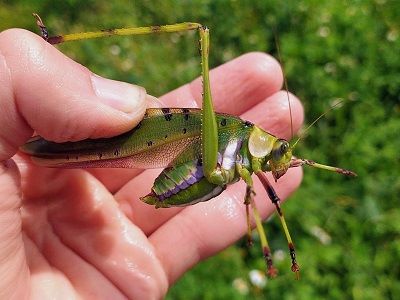
Ephippitytha trigintiduoguttata
Mottled Katydid
A large katydid that feeds on Eucalyptus leaves. Its brown spots and markings resemble a chewed leaf, camouflaging itself well while feeding. They can be found around Australia.

Tortricidae sp.
Leafroller moth
Caterpillars of this family roll themselves up a leafy shelter fastened with silk that they can live in.

Amata nigriceps
White Antenna Wasp Moth
A species of tiger moth. They are a diurnal (day-active) moth that advertises with bright colours that it is generally distasteful to most predators. The caterpillars are also covered in irritating hairs.

Tetragnatha rubriventris
Red-bellied Long-jawed Spider
A kind of orb weaver that lives close to water, preferring to build a web just above the surface to catch mosquitos. If they happen to fall in, they simply run across they surface, being quite nimble water striders. They have very elongated bodies and during the day often hide pressed up against a stick or leaf blade.

Dendrocnide moroides
Gympie stinging tree
Certainly a horrible tree to brush up against. I seem to have an unlucky affinity for them - even stinging me through jeans! Their hollow silica hairs inject numerous incredibly painful toxins which burn the area for days to weeks and even months afterwards. Not fun. If you're very careful you can eat the fruit (after removing the hairs which cover those too).

Pothos longipes
Candle vine pothos
One of Australia's two native pothos species, the other being the much rarer Pothos brassii. They grow mainly on tree trunks, as an epiphytic vine. Like most other climbing aroids, as they reach up into the canopy their leaf size increases dramatically to catch more light.

Alocasia brisbanensis
Cunjevoi Lily
One of two species of Alocasia (the elephant ears) native to Australia. This is the smaller one, usually growing to about 1-1.5m in height. They grow as an understory shade plant along the east coast in rainforests or moist temperate forests. They are very toxic and a bite of any part of the plant can cause burning pain and death.

You're always well below the canopy in the rainforest.