Kangaroos and other mammals
Central Desert, Australia
24/02/21

It's hard to imagine the heat if you're not here, but it feels like an oven with the rocks radiating even more heat back at you.
There are a fair few large kangaroos and ungulates around if you look hard enough. Even the largest can camouflage so well though that you rarely notice them until they get spooked and jump out from pretty much under your feet.
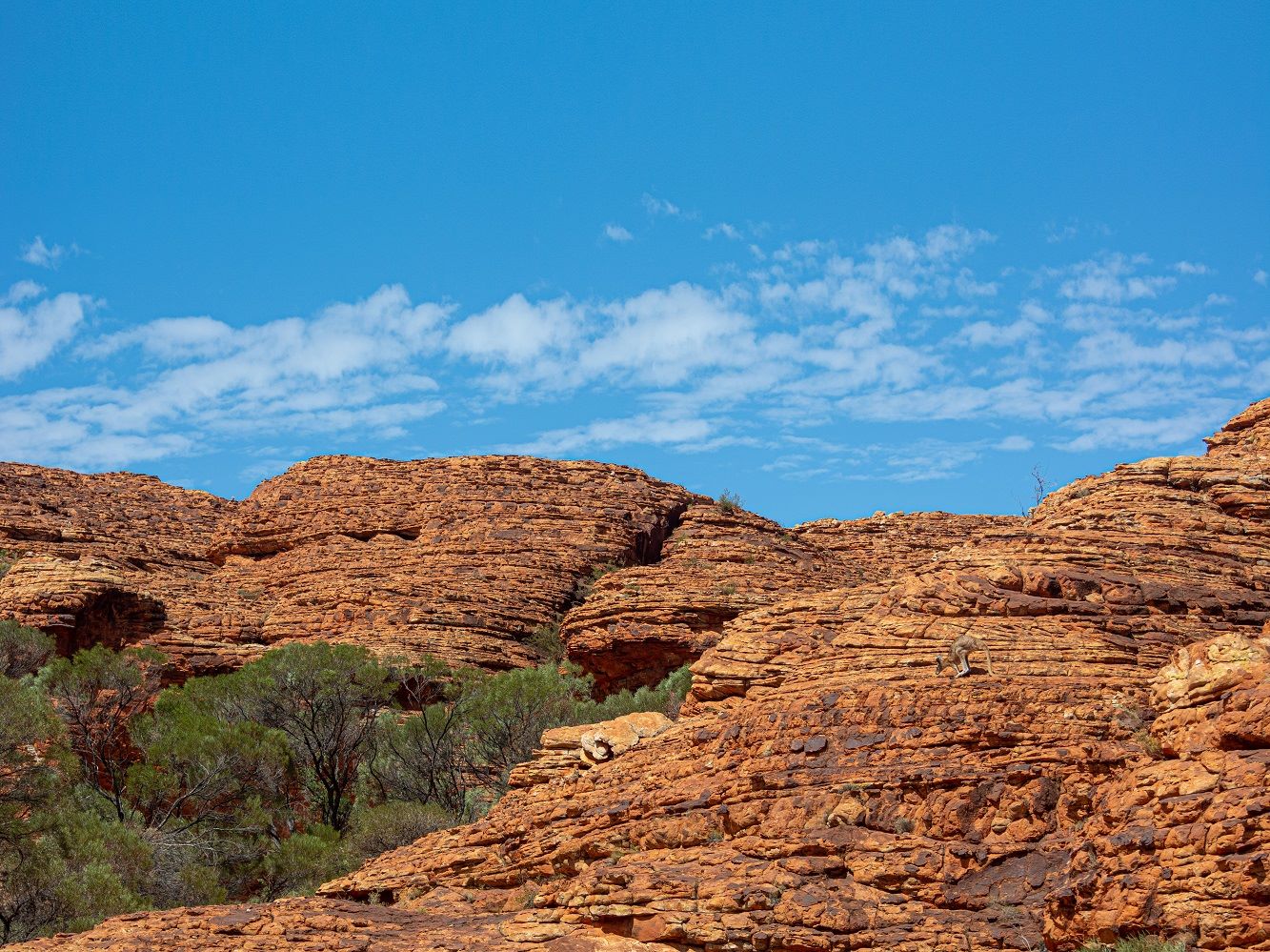
Do you see the kangaroo! Look in the lower right.
All of these species of kangaroo live in different habitats - red kangaroos are the big roamers of the desert and travel large distances across plains where some trees and shade can be found. The other species generally stick around rocky areas (especially the small rock wallabies) where they won't be eaten by dingoes. It's always extremely hot around here of course though, and the best bet for seeing them hopping around is early morning and sunrise. It's a very rewarding sight just walking through a barren landscape of minimal life and then seeing that classic kangaroo silhouette bounding across the horizon.

Osphranter rufus
Red kangaroo
The world's largest marsupial. Red kangaroos weigh up to 90kg and are very well adapted to desert life. They are very muscular with a powerful kick, which can be lethal!
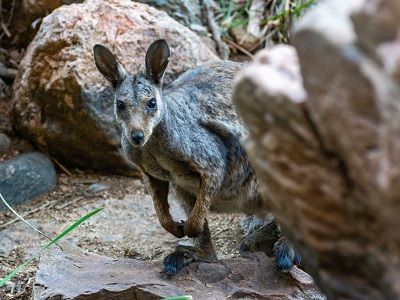
Petrogale lateralis centralis
Black footed rock wallaby
These small macropods live on steep rocky slopes and rocky outcrops. They eat mainly grass. and can survive without any other water source.

Osphranter robustus
Common wallaroo
This hardy, mostly nocturnal macropod can be found across Australia. They aren't particularly social and are usually found solitary or in a small family unit.

Osphranter robustus
Common wallaroo
A joey! The young kangaroos are so full of energy and pretty much jump around you in circles.

Camelus dromedarius
Dromedary camel
A spectacular creature to come across in the middle of nowhere, towering above you at over 3m head height. An introduced species, Australia now has about 3 million wild camels.

Equus ferus caballus
Brumby
Australia also has the world's largest wild population of feral horses. There are many different colour forms roaming around, but this was the first black one I've seen.

Walking along an almost dry salt lake. While all fairly similar, there are many different ecotypes in the desert.
Mammals aren't the only large animals roaming about the landscape however! Between the scraggly stands of acacia and mallee, emus also manage to remain very well camouflaged. The best chance for spotting these large creatures is to track their footprints - luckily the fine desert sand easily records even the lightest indentation. Sometimes you'll even hear the animals before you see them, be it the howl of a dingo or the 'whump' of an emu.
An emu doing his thing in the desert. Behind the camera is me lying face down in the burning sand, camouflaged. Emus are normally very flighty!